 SWRainAlert
Enforcement
You Got a Stormwater Violation Notice in South Carolina. Now What?
South Carolina does not work like Georgia, and a response written on Georgia assumptions will answer the wrong question. Here the weekly inspection is the obligation, and rainfall is a recordkeeping duty attached to it.
Most stormwater compliance writing treats the south-east as one rulebook. It is not, and South Carolina is the clearest example of why that matters. If you are holding a violation notice on an SC site and preparing to explain your 24-hour post-storm inspections, you may be defending yourself against a requirement your permit does not impose — while the one it does impose goes unaddressed.
The difference that changes everything
South Carolina’s construction general permit is SCR100000, administered by the South Carolina Department of Environmental Services. The frequency clause, in the text we have been able to verify, requires inspections “at a minimum of at least once every calendar week … until final stabilization is reached”, and then adds: “An inspection is recommended within 24 hours of the end of a storm event of 0.5 inches or greater.”
Read that second sentence again. Recommended. Georgia, Texas, Florida and North Carolina all impose a post-storm inspection as a deadline you can miss. South Carolina, on this language, does not.
This is not licence to ignore storms — and we will come to why — but it means the shape of an SC violation is different. A finding is much more likely to be “there is no inspection report for the week of 14 July” than “you missed the deadline after the storm on the 16th.”
Where our own certainty runs out. A 2026 SCR100000 was issued on 27 February 2026 and took effect on 30 March 2026. We have not been able to retrieve that document directly — the agency’s server refuses automated requests — so the language quoted above is from the earlier permit, which multiple secondary sources report as carried forward. That is a reasonable basis for an article and not a sufficient basis for a regulatory response. Read your own permit, or have counsel read it, before relying on the “recommended” distinction in writing to an agency.
The first 48 hours
- Correct any live condition — a failed control, an active discharge, an unstabilised area. Photograph it before and after, with dates.
- Freeze the records exactly as they are. Do not backfill the Rain Log. A Rain Log completed retrospectively in one sitting looks precisely like what it is.
- Notify the people with parallel obligations — owner, contractor, counsel. Contradictory accounts from two permittees on the same site are worse than one incomplete account.
- Assemble the weekly inspection reports for the whole period, in date order, and find the gaps yourself before the agency points at them.
The Rain Log is the exposure
Here is why “recommended” does not let you stop caring about rainfall. The same permit requires permittees to “either maintain an on-site rain gauge or use data from a certified weather record … to record rainfall records from any significant rainfall event, 0.5 inches or greater”, kept in a Rain Log in the on-site SWPPP — and rainfall for the day of an inspection, plus any significant events since the last one, “must be reported on each weekly inspection report.”
That is mandatory language, and it creates three ways to be in violation without ever missing an inspection:
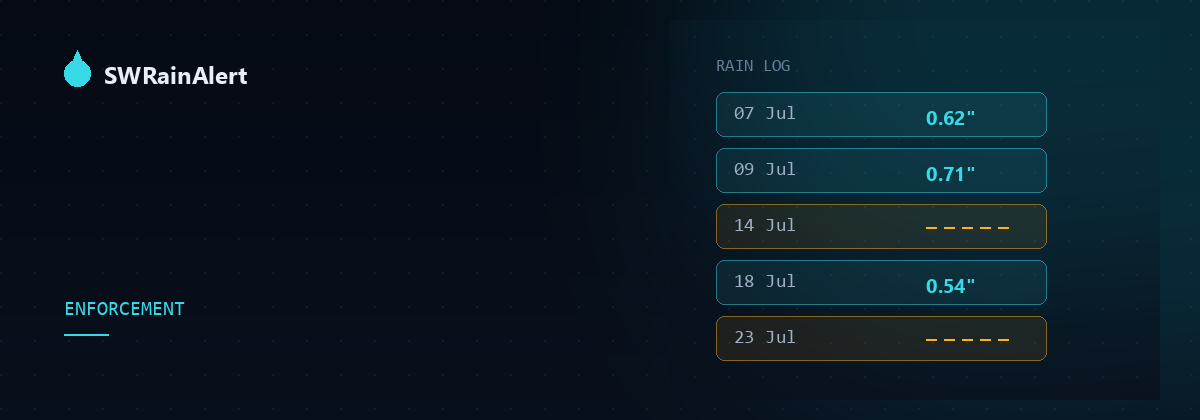
- No rainfall record at all for a period — no gauge readings, no certified weather data.
- A Rain Log that omits significant events. If 0.7″ fell on the 9th and the log has nothing for the 9th, the log is incomplete — and that is demonstrable from public data by anyone who cares to check.
- Weekly reports that do not carry the rainfall forward. A weekly report with those fields blank is an incomplete report even if the inspection itself was thorough.
That third one is the quiet killer, because the inspection genuinely happened and the crew genuinely walked the site. The finding is about a field on a form.
Note also the asymmetry in the agency’s favour: rainfall over your site is independently knowable. NOAA’s archives will show what fell at those coordinates whether or not anybody wrote it down. A Rain Log with gaps on days that demonstrably had significant rain is not a subtle finding to make.
What they will ask for
- The SWPPP, current and amended, with the on-site copy accounted for.
- Weekly inspection reports for the stated period, signed and dated.
- The Rain Log, and the source of the rainfall figures in it.
- Evidence that inspections continued until final stabilization on all areas — a common gap on sites that went quiet before they were finished.
- Anything additional your site carries because it discharges to Sensitive Waters, which can require more frequent inspection than the weekly baseline.
Writing the response
Answer the findings in the agency’s numbering, one section each: what you found on checking, the evidence attached and labelled, what was corrected and when, and what has changed procedurally. Two South Carolina-specific points of judgement follow.
On the “recommended” distinction
If a finding asserts a missed required post-storm inspection and your permit says recommended, that is a legitimate thing to raise — carefully, with the permit section quoted, and ideally through counsel. Do it as a factual clarification, not as a gotcha. Agencies respond badly to being lectured about their own permit, and the point is only worth making if you are certain of the version in force on your site.
On the Rain Log
If it has gaps, do not fill them now. Say what the log contains, supply retrospective NOAA data clearly labelled as retrospective, and describe the process change that means the log populates automatically from here. Reconstructed data honestly labelled is evidence. Reconstructed data presented as contemporaneous is something else entirely.
What changes afterwards
The weekly cycle stops depending on memory, because “the week of the 14th got away from us” is the single most common SC gap and a calendar obligation is the easiest kind to automate. The Rain Log stops being a manual column: significant events get recorded as they happen, with the source named, whether or not anyone chooses to inspect after them — because the recording obligation is real even where the inspection is advisory.
Common questions
Is a post-storm inspection required in South Carolina?
Under the permit language we have been able to verify, an inspection within 24 hours of the end of a storm of 0.5 inches or greater is recommended, not required. The mandatory frequency is at least once every calendar week until final stabilization. Confirm against your own permit, because this is materially different from how neighbouring states work.
What is the Rain Log and why does it matter?
South Carolina requires permittees to record rainfall from any significant rainfall event of 0.5 inches or greater, using either an on-site rain gauge or data from a certified weather record, and to keep those records in a Rain Log in the on-site SWPPP. Rainfall for the day of an inspection, and any significant events since the last inspection, must be reported on each weekly inspection report. That is mandatory language, which is why the Rain Log is usually the real exposure.
Can I use radar data instead of an on-site rain gauge?
The permit language permits either an on-site rain gauge or data from a certified weather record. Which applies to your site depends on your permit and your SWPPP, and where either names a gauge as the system of record, the gauge is the record.
Does the 2026 permit change any of this?
A 2026 SCR100000 took effect on 30 March 2026. We have not been able to retrieve its text directly, and secondary sources report the inspection and Rain Log language as carried forward. Treat that as unconfirmed and read your own permit before relying on any of it in a regulatory response.
A note on what this is. General guidance, not legal advice. Your permit, your SWPPP and your state’s requirements govern, and they differ. SWRainAlert is a monitoring and recordkeeping aid, not a compliance guarantee — where a permit names an on-site rain gauge as the system of record, the gauge is the record.