 SWRainAlert
Enforcement
You Got a Notice of Violation from TCEQ. Now What?
Texas has the clearest rainfall rule of any state we track, and the one most likely to be logged wrong — because TXR150000 counts the drizzle that nobody recorded as a storm.
The Texas Commission on Environmental Quality administers construction stormwater under the TPDES program, and its construction general permit — TXR150000, effective 5 March 2023, expiring 5 March 2028 — contains the most explicit rainfall language of any permit we monitor. That clarity cuts both ways. It is easy to know what the rule is. It is also hard to argue you misunderstood it.
What the letter is
TCEQ’s enforcement process moves in stages, from an initial notice of findings through to formal enforcement. The document you are holding states which stage it represents and what it requires of you. That matters more than it sounds: the appropriate response to an early notice with a corrective window is not the appropriate response to a formal enforcement action, and the difference is written on the page.
We are not going to characterise TCEQ’s procedure beyond what your letter tells you. Agency enforcement pathways have their own rules, escalation criteria and response mechanics, and they change. Your letter, TCEQ’s own current guidance, and your counsel are the authorities on where you are in that process. What this article can help with is the part that is the same regardless: assembling the factual record underneath the findings.
The first 48 hours
- Correct anything live. A control that has failed, an unstabilised area, a discharge. Photograph before and after, with dates.
- Freeze the records. No backfilling, no re-signing, no tidying. An amended log is a much worse problem than an incomplete one.
- Notify the parties with parallel duties. Texas sites frequently carry both a primary operator and secondary operators with distinct obligations under the same permit.
- Pull the rainfall record for the full period — then do the exercise in the next section before concluding anything about which storms qualified.
The cumulative rule that catches people
Part III.F.8.(c) requires inspections “at least once every fourteen (14) calendar days and within 24 hours of the end of a storm event of 0.5 inches or greater”, and then spells out the part that does most of the work: “If a storm event produces 0.5 inches or more of rain within a 24-hour period (including when there are multiple, smaller storms that alone produce less than 0.5 inches but together produce 0.5 inches or more in 24 hours), you are required to conduct one inspection within 24 hours of when 0.5 inches of rain or more has fallen.”
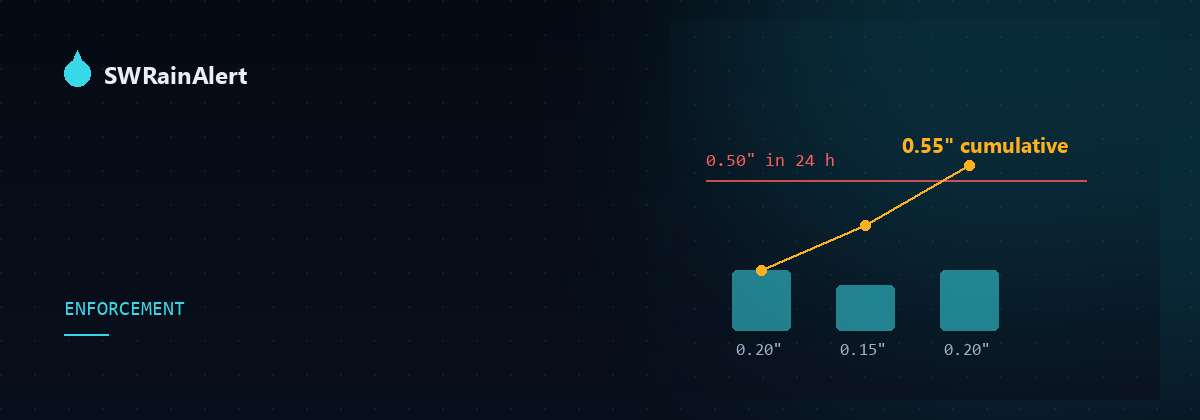
Texas is telling you, in the permit itself, that the measurement is a rolling 24-hour accumulation and not a list of discrete named storms. Three showers of 0.2″, 0.15″ and 0.2″ across an afternoon and evening total 0.55″ and trigger the requirement. None of them individually would appear in most site logs as anything at all.
This is the single most common way a Texas site ends up with a real gap while everyone believes the program is running properly. Nobody ignored a storm. There was no storm — there was weather, three times, and the total crossed a line nobody was adding up. We have written about the general version of this in rolling 24 hours versus the calendar day; Texas is the state where the permit text removes any argument about it.
Before you respond to a Texas finding, re-derive the qualifying events from rainfall data on a rolling basis, not from your log’s list of storms. You may find the agency’s list is right and yours was incomplete. Better to know that while drafting than to assert otherwise and be corrected.
“Entirely outside” means entirely
The same clause continues: “When the 24-hour inspection time frame occurs entirely outside of normal working hours, you must conduct an inspection by no later than the end of the next business day.”
The word entirely is load-bearing, and it is routinely read as though it were not there. If 0.5″ is reached at 16:00, the 24-hour window runs to 16:00 the following day — overlapping two working days. The extension does not apply. A response that leans on the after-hours provision for a storm that finished mid-afternoon will be corrected, and it invites closer reading of everything else you filed.
Note also that Texas counts from when 0.5 inches has fallen, which is a different instant from the end of the storm. Georgia counts from the end of the storm. If you run sites in both states on one procedure, one of those two is being computed wrongly right now.
What they will ask for
- The SWPPP, current, with amendments, matching the site as built.
- Inspection reports for the period — both the 14-day cycle and every rain-triggered inspection.
- Rainfall records with a named source, sufficient to show which periods reached 0.5″ in 24 hours.
- Your site notice or permit authorisation documentation, and confirmation it is current and correctly posted.
- Corrective actions, with completion dates, and evidence of final stabilization where claimed.
Writing the response
Answer each finding in the agency’s own numbering: what you established on checking, the labelled evidence, the correction with its completion date, and the procedural change that prevents recurrence. Two things are worth doing in a Texas response specifically.
Show your accumulation working
If a finding turns on whether a period qualified, do not simply assert a total. Show the rainfall by interval, the 24-hour window you applied, the source, and the resulting total. A regulator can check that. An unsourced number in a sentence invites the question of where it came from.
Address the 14-day cycle separately
The routine cycle and the rain events are independent obligations in Texas — unlike Georgia, a rain inspection does not reset the routine cycle here. Responses that blur them together tend to leave one of the two unanswered, and it is usually the routine one.
What changes afterwards
The accumulation stops being something a person adds up. The permit describes a rolling calculation; a spreadsheet of daily totals is not that calculation, and the gap between the two is exactly where the missed events live.
The deadline stops being computed by hand. Texas counts 24 hours from when the threshold was reached, with a narrow after-hours extension and a next-business-day rule attached. Those are three interacting rules and a local timezone — and a site evaluated in UTC lands five or six hours off, which inside a 24-hour window is enough to move the deadline onto the wrong day.
Common questions
What rainfall triggers an inspection in Texas?
Under TXR150000, 0.5 inches or more of rain within a 24-hour period, with one inspection required within 24 hours of when 0.5 inches has fallen. The permit explicitly counts multiple smaller storms that individually produce less than 0.5 inches but together reach 0.5 inches or more in 24 hours.
Do several small showers count towards the threshold?
Yes, and this is unusually explicit in TXR150000. Multiple smaller storms that alone produce less than 0.5 inches but together produce 0.5 inches or more within 24 hours trigger the inspection requirement. A log that only records discrete storms will miss these entirely.
What if the 24-hour window falls outside working hours?
TXR150000 provides that when the 24-hour inspection time frame occurs entirely outside of normal working hours, the inspection must be conducted by no later than the end of the next business day. Note the word entirely: if any part of the window falls within working hours, the extension does not apply.
How often are routine inspections required in Texas?
At least once every fourteen calendar days, separately from the rain-triggered inspection. Texas's routine cycle is longer than Georgia's seven days, which means the rain trigger carries proportionally more of the compliance load — and a rain inspection does not reset the 14-day cycle.
A note on what this is. General guidance, not legal advice. Your permit, your SWPPP and your state’s requirements govern, and they differ. SWRainAlert is a monitoring and recordkeeping aid, not a compliance guarantee — where a permit names an on-site rain gauge as the system of record, the gauge is the record.