 SWRainAlert
How measurement works
Rolling 24 Hours vs Calendar Day: The Storm Your Log Missed
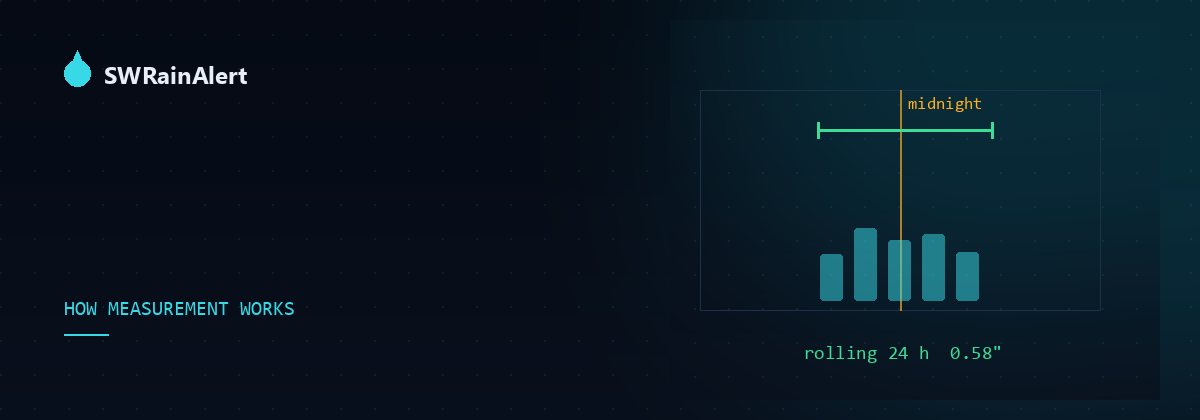
A storm that runs from 22:00 to 02:00 is one event. Measured against calendar days it becomes two totals, neither of which crosses the threshold.
This is the most consequential piece of arithmetic in stormwater monitoring, and it is almost never discussed: over what 24 hours?
The midnight split
Consider a Georgia site, where the trigger is 0.5″ in 24 hours. Rain starts at 21:40 and stops at 01:20. Total accumulation: 0.58″. That is a qualifying event and it starts a 24-hour inspection clock.
Now measure it against calendar days. Tuesday records 0.30″. Wednesday records 0.28″. Both are comfortably under the threshold. Nothing triggers, nothing is logged as a qualifying event, and nobody inspects — after a storm that unambiguously qualified.
Nothing about this is exotic. Overnight convective rain is ordinary weather across most of the country. Any system that accumulates against the calendar date will under-report qualifying events, systematically, for as long as it runs.
The opposite error
A pure rolling window solves the split but creates a second problem. If the window simply totals the last 24 hours at all times, then two genuinely separate storms — one at 6am, another at 8pm — get added together. The 8pm storm inherits the morning’s accumulation, may cross the threshold on a total it did not produce, and worse, the morning’s event is never closed.
That second consequence is the damaging one. If the first event stays open, the second storm does not generate a new alert or a new deadline, because as far as the system is concerned nothing changed state. The second storm gets silently absorbed into the first.
The dry gap
The mechanism that separates them is a dry gap: a defined period with no accumulation, after which the current rain event is closed and the next storm starts from zero with its own alert and its own deadline.
SWRainAlert uses six hours. After six hours with no accumulation the event closes, its inspection clock stops, and the next storm builds an entirely fresh total. It is a small rule with an outsized effect — without it, the second storm of a busy afternoon is invisible, which is the most damaging bug this category of product can have.
Worth asking any vendor. “What happens on the second storm of the same day?” The answer tells you whether they have thought about event boundaries at all, or are simply totalling a column.
What this means for your records
- A rainfall log organised strictly by calendar date cannot, on its own, show that you evaluated events correctly.
- Record the event — start, end, total, and the threshold it was measured against — not just a daily number.
- Where two storms occur in one day, they should appear as two events with two deadlines, not one line item.
- If your total for a day exceeds the threshold but no inspection was performed, the record needs to explain why, at the time, not in hindsight.
Common questions
Is the SWPPP rainfall threshold measured per calendar day?
Generally no. Permits specify a storm event measured over a 24-hour period, which is a rolling window. A storm that spans midnight is one event, and splitting it into two calendar-day totals can under-report a qualifying event.
What if two storms happen on the same day?
They should be treated as two separate events, each with its own accumulation total, its own alert and its own inspection deadline. The separator is a dry period with no accumulation; SWRainAlert uses six hours.
How long is the inspection deadline after a qualifying storm?
Most state permits require the inspection within 24 hours of the qualifying event, though the details differ. North Carolina, for example, frames it in business hours. Always compute the deadline in the site's own local time, not UTC or head-office time.
A note on what this is. General guidance, not legal advice. Your permit, your SWPPP and your state’s requirements govern, and they differ. SWRainAlert is a monitoring and recordkeeping aid, not a compliance guarantee — where a permit names an on-site rain gauge as the system of record, the gauge is the record.