 SWRainAlert
Documentation
What Makes a Stormwater Inspection Record Defensible
An inspection nobody can evidence is, for enforcement purposes, close to an inspection that never happened. Here is what a record needs to carry.
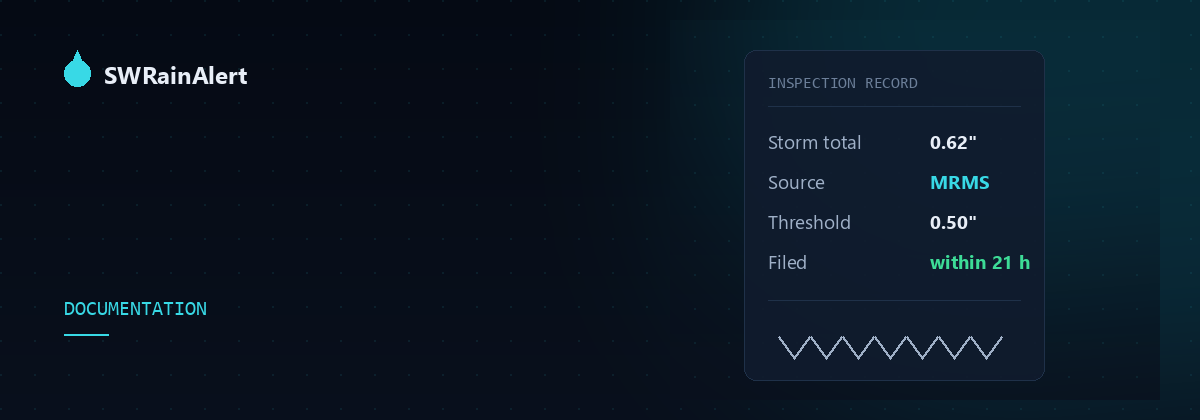
Most stormwater programs fail their audit on paperwork rather than practice. The crews did the work; the file cannot show it. These are the four properties that separate a record which holds up from one that does not.
1. Contemporaneous
A record written on the day carries weight that a record assembled at the end of the quarter does not. This is not a technicality; it goes to whether the document reflects observation or recollection.
The practical failure is familiar: an inspection is performed on Friday, the form is filled in on Tuesday from memory and a few phone photos, and the date written on it is Friday. The document now asserts something about when it was created that is not true, and if that is ever established, everything else in the file becomes questionable too.
The fix is to make filing on site the path of least resistance — which in practice means the form has to work with no signal, because construction sites frequently have none.
2. Attributable
Permits generally require the inspection to be performed by a qualified person, and several states are specific about the qualification. Georgia’s form expects the GSWCC certification number of the individual inspecting. A report without it is not a complete Georgia report, however thorough the observations.
“Inspected by: site team” is not attribution. Neither is a shared login. If three people can file under one account, the record cannot establish who was actually standing on the site, and the certification requirement becomes unverifiable.
3. Complete
Completeness means every field the permit names, and one that is easy to overlook: the rainfall amount and its source.
This is where a lot of otherwise good records get weak. The form asks for a rainfall figure; somebody writes 0.6″. Six months later nobody can say where that number came from — the site gauge, a phone weather app, or a recollection. A figure with no attribution is difficult to defend and easy to challenge.
A complete entry states the amount, the source, and ideally the measurement window: 0.62″ over 24 hours, NOAA MRMS radar estimate, or 0.60″, on-site gauge, read 07:15. Both are defensible. “0.6” alone is not.
Never let a tool put a number on your form that it cannot attribute. Prefilling an inspection with a gauge reading the software never saw is fabrication, however convenient. If SWRainAlert prefills a rainfall figure, it labels the source as a NOAA radar estimate, because that is what it is.
4. Unaltered
A signed inspection that can be edited afterwards is not evidence. If the document can change, then what it says today tells you nothing reliable about what was observed and certified on the day.
Handled properly, a filed inspection is immutable, and a correction is a new record that references the original. That preserves both the finding and the fact that it was corrected — which is a stronger position than a file that silently shows only the corrected version.
The related trap is the draft. An unfinished form sitting in an evidence pack reads, to anyone reviewing it, as a claim that an inspection happened. Drafts should be visibly drafts and should never appear in an export of filed records.
The photo problem
Photographs are the most persuasive part of most inspection files and the easiest to weaken. A photo with no timestamp, no location, and no link to a specific inspection proves that a condition existed somewhere, at some point. Attached to the inspection it belongs to, with the capture time preserved, it proves considerably more.
A quick self-audit
- Pick a filed inspection from four months ago at random.
- Can you tell who performed it, and does their certification appear?
- Does it state a rainfall amount and where that amount came from?
- Can you show it has not been modified since it was signed?
- Do its photos connect to that inspection, with capture times?
- If a corrective action was opened, can you show when it was closed and by whom?
Any “no” is a gap that will be much cheaper to close now than during an enforcement conversation.
Common questions
What must a SWPPP inspection report include?
Requirements vary by permit, but generally: the date and time of inspection, the name and qualification of the inspector, the rainfall amount that triggered it where applicable, observations of each control measure, any deficiencies found, corrective actions with dates, and a signature or certification. Check your own permit's form and required fields.
How long must stormwater inspection records be kept?
Retention periods are set by the permit, and three years after coverage is terminated is a common requirement, though it varies. Check your permit text, and keep records longer if any enforcement matter is open.
Can an inspection report be edited after it is signed?
It should not be. A signed record that can be altered afterwards has little evidentiary value. The defensible approach is to treat a filed inspection as immutable and issue a correction as a new record referencing the original, so both the finding and the correction remain visible.
A note on what this is. General guidance, not legal advice. Your permit, your SWPPP and your state’s requirements govern, and they differ. SWRainAlert is a monitoring and recordkeeping aid, not a compliance guarantee — where a permit names an on-site rain gauge as the system of record, the gauge is the record.