 SWRainAlert
Multi-state programs
Running Sites in Several States Under Different Permits
Standardising on the strictest state looks safe and is expensive. Standardising on the loosest is cheap until an inspector arrives. Neither is the answer.
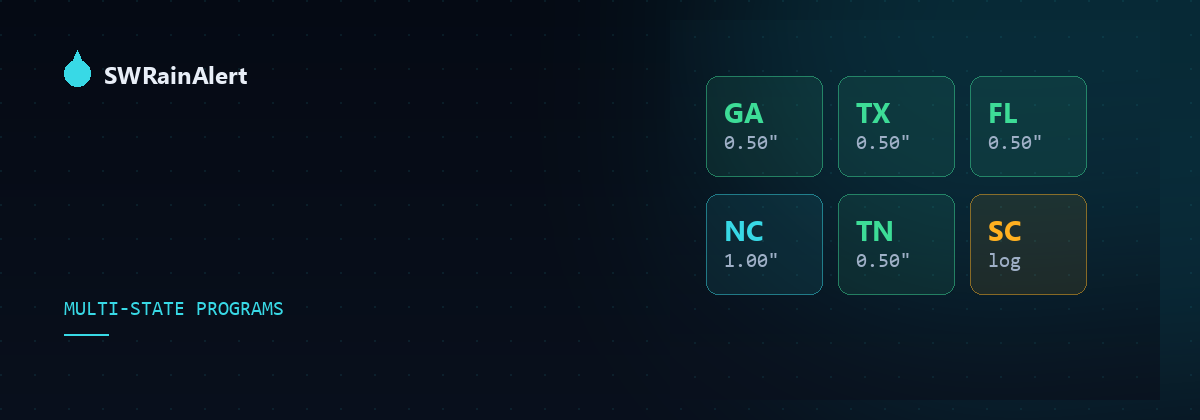
A contractor or consultant working in one state can run compliance from memory. Add a second state and that stops being true — usually without any obvious moment where it stopped.
What actually differs
| What varies | Example | Consequence if standardised |
|---|---|---|
| Rainfall trigger | 1.00″ in NC, 0.50″ in GA | Missed events, or inspections nobody required |
| Measurement window | Rolling 24 h in most states | Events split or merged incorrectly |
| Response window | 24 h; NC frames it in business hours | Deadlines computed on the wrong day |
| Routine frequency | 7 days in GA; 14 days in TX | A whole obligation missed — routine inspections are not rain-triggered |
| Required form | GA expects the GSWCC certification number | Reports that are complete in one state and incomplete in another |
Five axes of variation across state construction general permits
The routine frequency row is the one that catches teams out. Rain-triggered inspections are the visible obligation, so a tool that only tracks storms can leave a team confident while half the requirement — the calendar-driven inspection — is being managed in a spreadsheet, or not at all.
Why standardising fails in both directions
The instinct is to pick one procedure and apply it everywhere. Both versions of that have real costs.
Standardising on the strictest
Run every site at Georgia’s 0.5″ and North Carolina crews inspect roughly twice as often as their permit requires. That is real money and real hours, and it erodes the credibility of the program on site — once people conclude the rules are arbitrary, the ones that matter get treated the same way.
Standardising on the loosest
Run everything at 1.00″ and Georgia sites simply miss qualifying events. This failure is invisible until an inspector asks why there is no report for a storm the record shows you observed.
The workable model
- Thresholds live on the site, not on the company. Each site carries its own trigger, window and response time, derived from its state and then editable when the individual permit is stricter.
- Deadlines are computed in the site’s timezone. A firm in Atlanta managing sites in Texas has to reason in two clocks; the software should do that rather than the person.
- Routine and rain-triggered obligations run side by side. Both belong in the same view, because both are the permit.
- Forms are per-state. Sharing one generic form across states produces reports that are incomplete in the states with specific requirements.
- Permit expiry dates are tracked as a program task. Every permit has one, and a reissue can change the numbers your procedures are built on.
The timezone trap
This one is worth isolating because it is easy to get wrong and hard to spot. A 24-hour deadline computed in UTC for a Georgia site lands four to five hours off local time. Inside a 24-hour window that is often enough to move the deadline onto the following calendar day — so a team believing they have until end of day Saturday is actually late by Friday evening.
For a multi-state program the failure compounds, because head-office time is correct for exactly one of your regions. SWRainAlert requires a real timezone for every site and refuses to create one it cannot derive, precisely because a defaulted timezone produces a confidently wrong deadline.
For consultants specifically
Firms managing compliance across several clients carry a version of this problem with an extra dimension: the sites are not yours, the permits are not uniform, and the records have to be separable per client for handover or audit.
- Keep per-client separation in the record structure from day one; reconstructing it later is painful.
- Assign every site an owning inspector so nothing sits unclaimed between people.
- Watch the portfolio by exposure — what is overdue — rather than by client, or the quiet clients get quietly neglected.
Common questions
How do I manage SWPPP compliance across multiple states?
Hold the requirements per site rather than per company: each site carries its own rainfall trigger, measurement window, response time, routine inspection frequency and state form, derived from its location and editable where the individual permit is stricter. Compute deadlines in each site's local timezone, and track permit expiry dates per state.
Can I use the same SWPPP inspection form in every state?
Not safely. Several states require specific fields, such as Georgia's expectation of the inspector's GSWCC certification number. A generic form may be complete in one state and incomplete in another, and an incomplete report is a documentation finding waiting to happen.
Do routine inspections still apply if it does not rain?
Yes. Most permits require routine inspections on a fixed calendar frequency regardless of rainfall, commonly every 7 or 14 days, in addition to rain-triggered inspections. A rain-triggered inspection does not reset the routine clock.
A note on what this is. General guidance, not legal advice. Your permit, your SWPPP and your state’s requirements govern, and they differ. SWRainAlert is a monitoring and recordkeeping aid, not a compliance guarantee — where a permit names an on-site rain gauge as the system of record, the gauge is the record.